.svg)
How Do Marketplace Owners Make Money? (And How to Launch Yours)
 By Infinitie Technologies11 min read

Marketplace owners earn in five main ways: commission on each sale, seller subscriptions, listing fees, ads and featured spots, and paid services like delivery. Most start with one core model and add the rest as they grow. In India, commission is shrinking. Meesho charges none, and Flipkart and Amazon India have cut it for low-priced products. So new marketplaces should keep seller fees low and earn more from ads and services over time.
How Do Marketplace Owners Make Money? (And How to Launch Yours)
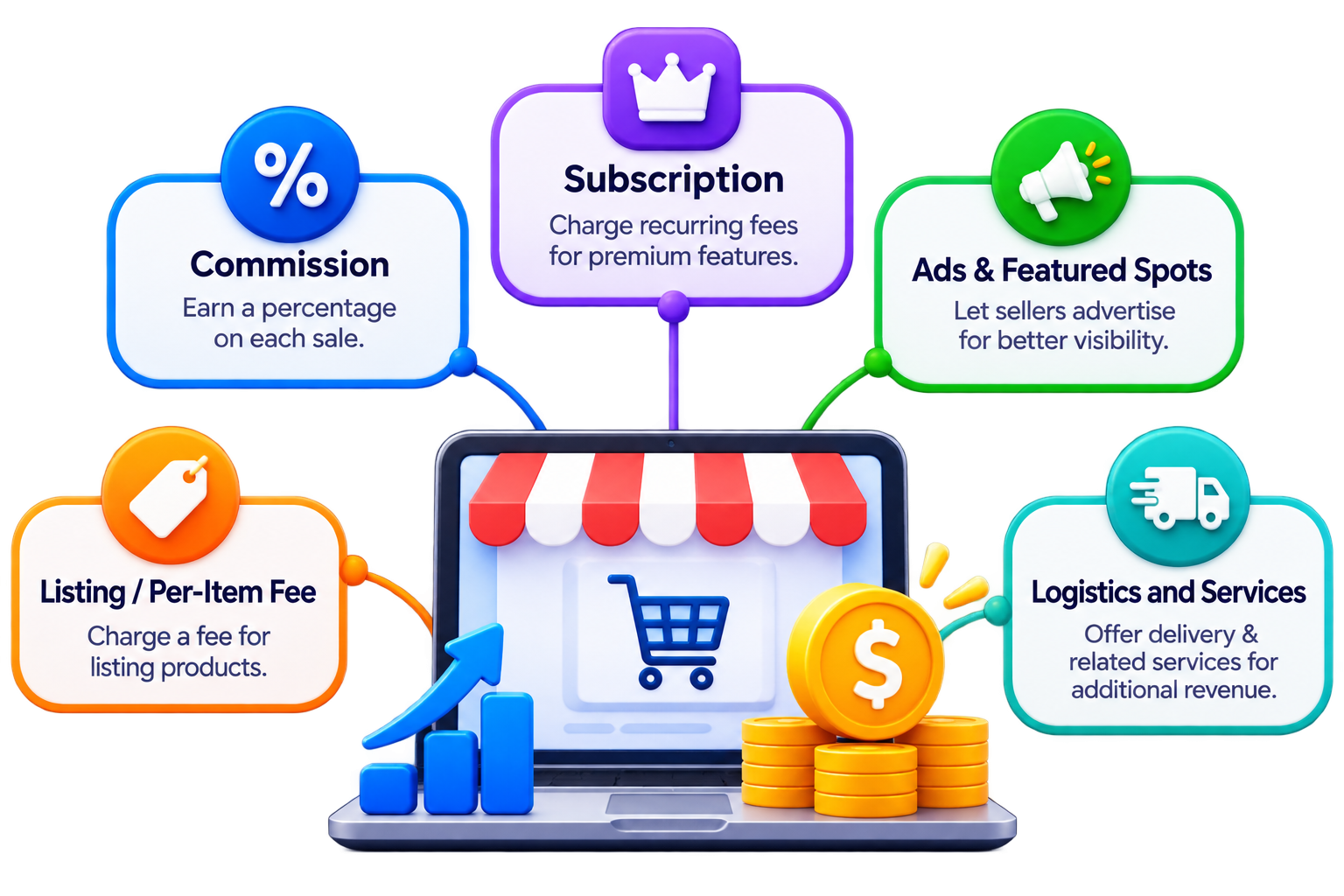
Quick answer: Marketplace owners earn money in five main ways: a commission on each sale, subscription fees from sellers, listing fees, advertising and featured spots, and paid services like delivery or payments. Most start with one core model, usually commission or a subscription, and add other income streams as the marketplace grows.
How do marketplace owners make money?
A marketplace owner doesn't sell the products. Sellers do. The owner earns by charging for access to buyers, tools, and services. Here is the quick overview:
| Revenue model | How it works | Real example |
|---|---|---|
| Commission | A percentage of every sale | Amazon charges about 15% on most categories |
| Subscription | Sellers pay a monthly or yearly fee | Amazon's Professional plan at $39.99 a month |
| Listing / per-item fee | Sellers pay for each product listed or sold | Amazon's Individual plan at $0.99 per item sold |
| Ads and featured spots | Sellers pay for more visibility | Meesho and Amazon sell ads to sellers |
| Logistics and services | Fees for delivery, fulfilment, or payments | Meesho earns from logistics; Amazon from FBA |
What is the commission model?
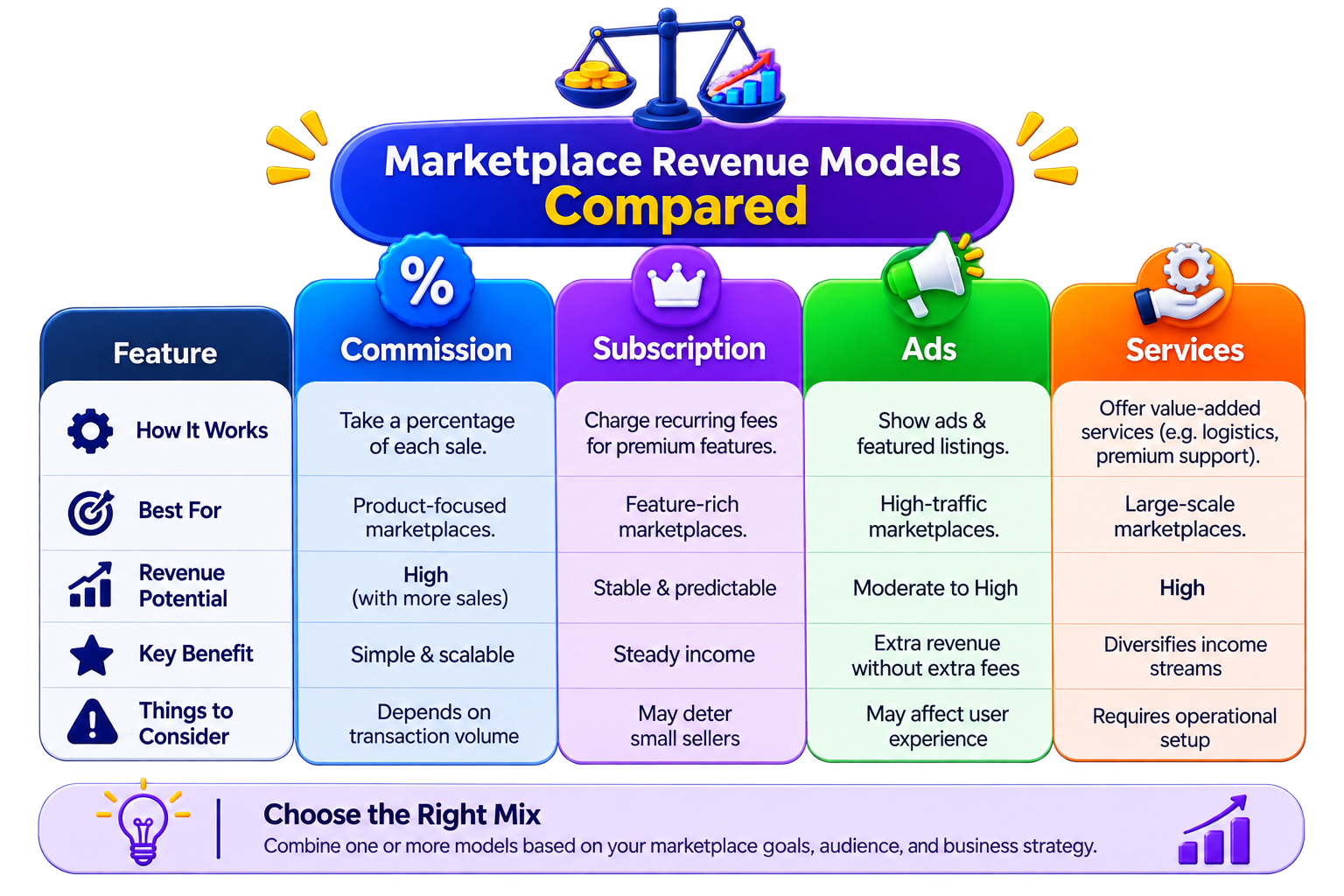
Commission is the most common way marketplaces earn. You take a small percentage of every sale, so you only make money when your sellers do. According to Amazon Seller Central data compiled by Novadata, Amazon charges a referral fee of about 15% on most sales. In India, Amazon and Flipkart have generally charged between 5% and 25%, depending on the category (Upstox).
- Good because: it's simple, fair, and grows with your sales.
- Watch out for: high rates can push small sellers away, and income stays low until you have real order volume.
What is the subscription model?
With a subscription, sellers pay a fixed fee to sell on your platform, whether they sell a lot or a little. Amazon is a good example. Its Professional plan costs $39.99 a month with no per-item fee, while the Individual plan is free to join but charges $0.99 per item sold. The Professional plan becomes cheaper once a seller passes about 40 items a month (Feedvisor).
- Good because: you get steady, predictable income even in slow months.
- Watch out for: new sellers may hesitate to pay before they've made a single sale.
What are listing and per-item fees?
Some marketplaces charge a small fee each time a seller lists a product, or each time one sells. It works like the Amazon Individual plan above. It's easy to understand, but it adds up for sellers with large catalogues, so keep it low.
How do ads and featured listings make money?
Once your marketplace has buyers, sellers will pay to be seen first. Ads, sponsored products, and featured spots are a strong income stream because they scale with traffic, not with sales. Inc42 notes that Meesho's ads business is important because it keeps sellers coming back, even though the platform doesn't charge commission.
How do logistics and services make money?
You can also earn by offering services that sellers need: delivery, fulfilment, payment processing, or storage. Meesho earns mainly from logistics, advertising, and other seller services. Its marketplace segment brought in ₹12,614 crore in revenue in FY26 (Inc42). Amazon's fulfilment fees (FBA) work the same way.
One thing to keep in mind: fees stack. Marketplace Pulse data reported by ZonGuru suggests that when you add up referral, fulfilment, storage, and advertising costs, Amazon's total cut can reach up to about 50% of a seller's revenue. Sellers notice this, so be fair and clear about what you charge.
Is zero commission the new normal in India?
It's becoming common, especially for low-priced products. Meesho already runs a zero-commission model and earns from logistics and ads instead. Then Flipkart introduced zero commission for eligible products under ₹1,000 in November 2025 (Business Standard), and later removed the price cap for fashion sellers. Amazon India followed in March 2026, extending zero referral fees to products priced up to ₹1,000 across more than 1,800 categories (Business Standard).
What does this mean for a new marketplace owner? Competing only on commission is getting harder. A smarter plan is to keep seller fees low, grow your order volume, and earn from ads and services on top.
Which mix of income streams fits your marketplace? It depends on your niche, your sellers, and your goals, and it's worth thinking through before you build.

How do you choose the right revenue model?
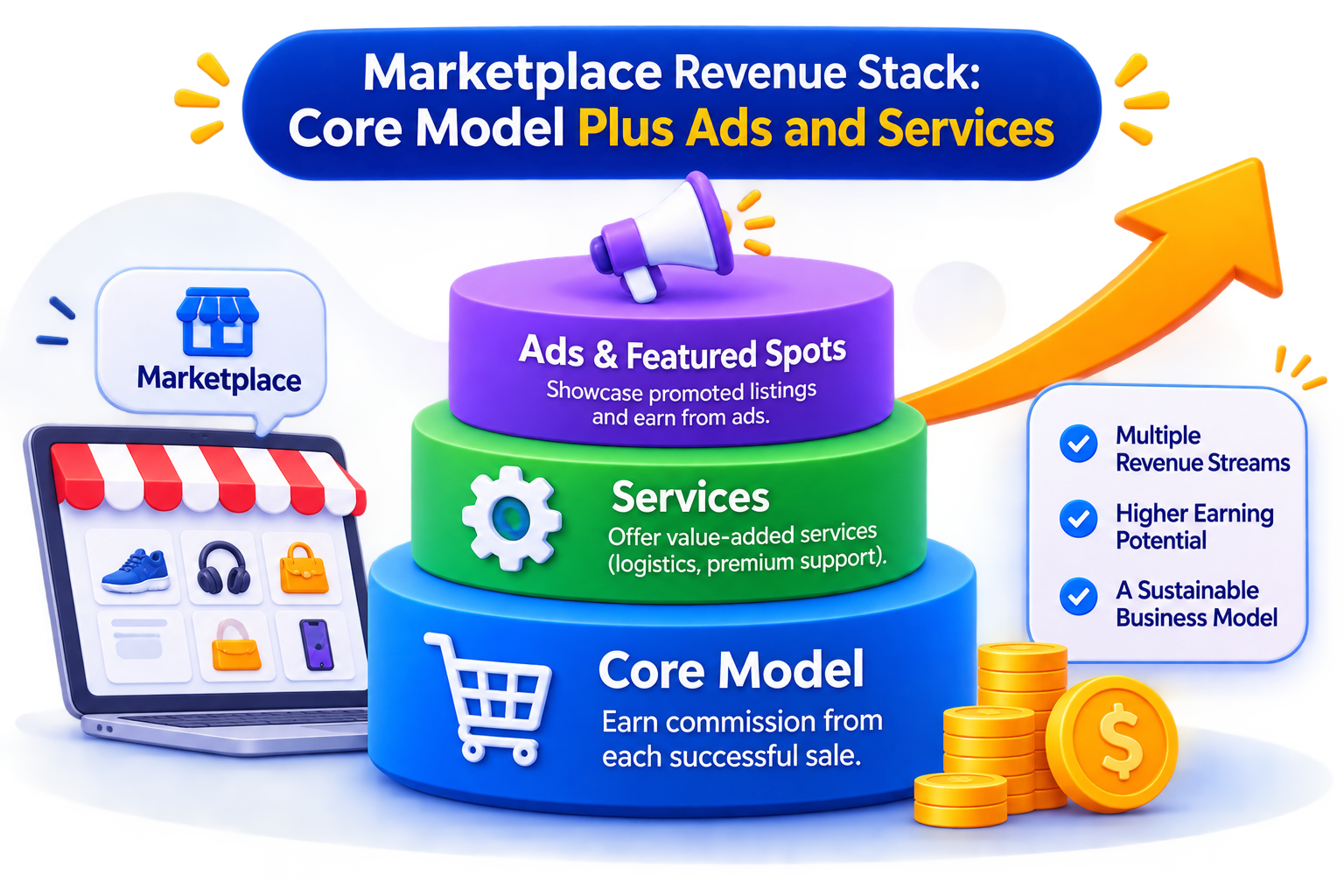
We call the smart way to do this the Marketplace Revenue Stack: start with one core income model, then add extra layers as your marketplace grows. Here is how to build it:
- Know your sellers. Small sellers with thin margins need low fees. Bigger brands can handle commission or subscriptions.
- Pick one core model. Choose commission or a subscription, not five at once.
- Start low to attract sellers. A marketplace with few sellers earns nothing, so keep early fees small or free.
- Add boosters later. Once you have steady traffic, add ads and featured listings.
- Review every month. Check whether sellers stay, earn, and come back, and adjust your fees.
| Marketplace stage | Best revenue model | Why |
|---|---|---|
| Just launched | Low or no commission | You need sellers first |
| Growing | Commission or subscription | Steady income as orders rise |
| Established | Core model plus ads and services | Traffic is valuable, and sellers want to be seen |
Does your marketplace software support these models?
Before you pick software, check that it can handle the models you plan to use, such as commission rates, vendor payouts, and featured listings. A ready-made multi-vendor product like HyperCommerce gives you a vendor-ready marketplace base with Flutter apps, a Laravel admin panel, and a website, and you can customize it as your revenue plan grows. Not sure what you'll need? Ask our team on WhatsApp.
Key terms to know
- Take rate
- The share of each sale that the marketplace keeps, such as 10%.
- Referral fee
- Amazon's name for its commission on each sale.
- GMV (Gross Merchandise Value)
- The total value of goods sold on your platform before costs and commissions.
- Featured listing
- A paid spot that shows a seller's product higher up in search or on the homepage.
- Fulfilment fee
- A charge for storing, packing, and shipping a seller's order.
Want to go deeper? Browse our blog for guides on building a multi-vendor marketplace, quick commerce, and delivery apps.
Frequently asked questions
How do marketplace owners make money?
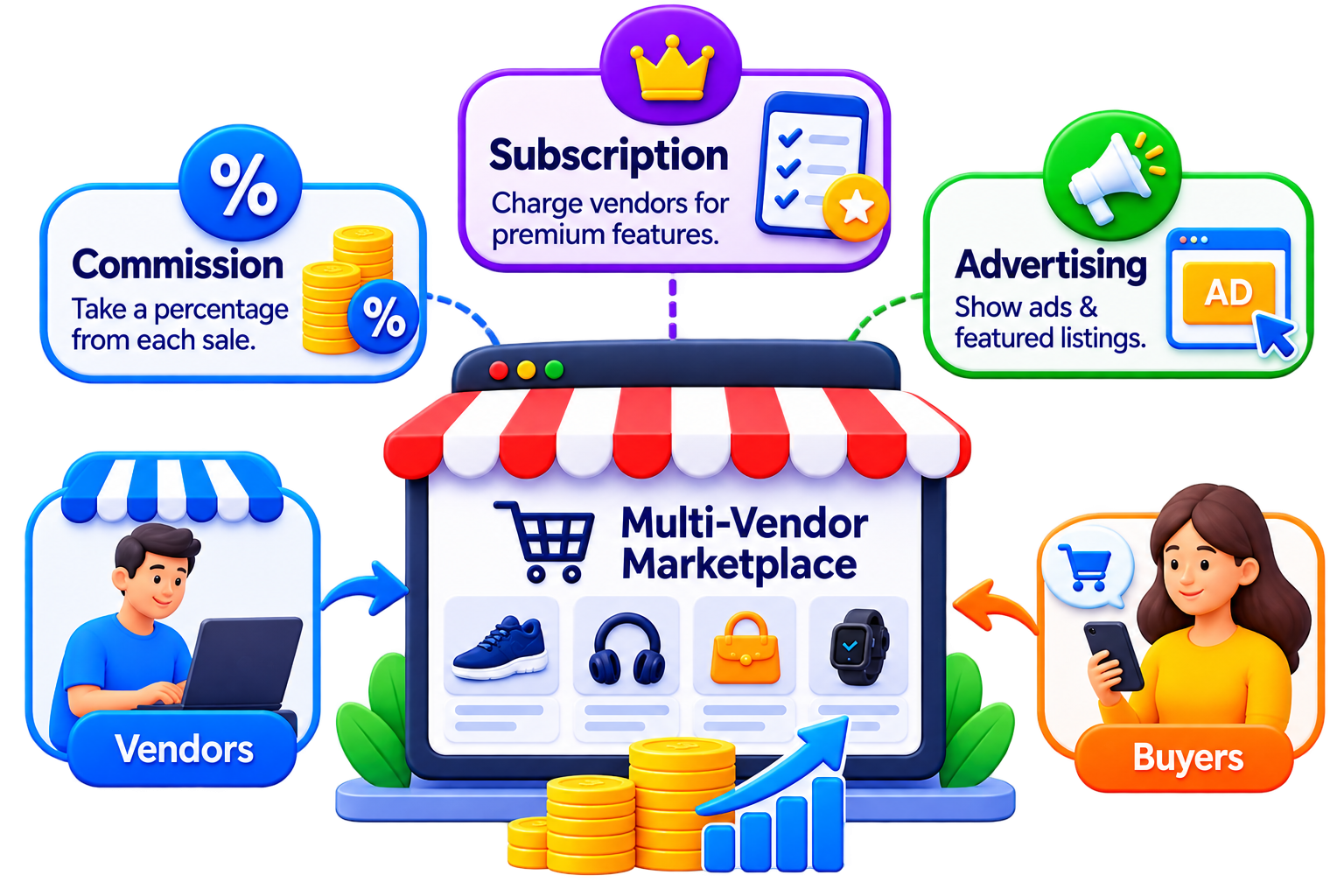
Marketplace owners earn through commission on each sale, seller subscriptions, listing fees, advertising and featured spots, and paid services like delivery or fulfilment. Most start with one core model and add more over time.
What is the most common marketplace revenue model?
Commission is the most common. The marketplace keeps a percentage of every sale, so it only earns when its sellers earn. Many marketplaces add ads or subscriptions on top.
What is a typical marketplace commission rate?
It varies by category. Amazon charges about 15% on most products, and in India, Amazon and Flipkart have generally charged between 5% and 25%. Smaller marketplaces often charge less to attract sellers.
Can a marketplace make money with zero commission?
Yes. Meesho charges sellers no commission and earns from logistics, advertising, and other seller services instead. This works best when order volume is high.
Is a subscription or commission model better for a marketplace?
Commission suits new marketplaces because sellers pay only when they sell. Subscriptions suit marketplaces with steady, higher-volume sellers because they give predictable income. Many use both.
How does Amazon make money from sellers?
Amazon charges a selling plan fee, a referral fee on each sale, and extra fees for fulfilment, storage, and advertising. Together these can add up to a large share of a seller's revenue.
How much should I charge sellers on a new marketplace?
Start low, or free, so you can attract good sellers. Once you have steady orders and traffic, you can raise fees gradually or add paid options like ads and featured listings.
Ready to build your marketplace?
If you want to launch a multi-vendor marketplace without building from zero, take a look at HyperCommerce. Have an idea but feeling stuck? Message our team on WhatsApp and we'll help you plan the first steps.