.svg)
How to Build a Multi-Vendor Marketplace Like Amazon or Flipkart
 By Infinitie Technologies11 min read

A multi-vendor marketplace lets many sellers list products on one platform while you earn a share of each sale, like Amazon or Flipkart. To build one: pick a niche, recruit good sellers, set up secure payments, choose your software, then launch small and grow. Custom builds can cost ₹4 lakh to ₹85 lakh or more, while ready-made source code like HyperCommerce is faster and cheaper.
How to Build a Multi-Vendor Marketplace Like Amazon or Flipkart
Quick answer: To build a multi-vendor marketplace, pick a focused niche, recruit sellers, set up secure payments and trust, choose your software (build custom or use ready-made source code), then launch small and scale. Ready-made source code is usually the faster, lower-risk route for first-time founders.
What is a multi-vendor marketplace?
A multi-vendor marketplace is an online platform where many independent sellers (vendors) list and sell their products to buyers in one place. You, the marketplace owner, run the platform and earn a share of each sale. Amazon, Flipkart, Meesho, and Etsy all work this way.
There are three roles to know:
- Vendors: list products, manage stock, and ship orders.
- Buyers: browse, compare, and buy from different sellers in one cart.
- Operator (you): manages the platform, payments, rules, and support.
This is different from a single-vendor store, where one business sells only its own products. In industry terms, selling your own stock is "first-party" (1P) and letting others sell on your platform is "third-party" (3P).
Why are multi-vendor marketplaces so popular?
Because sellers do the heavy lifting. As the owner, you don't have to buy or store inventory. The proof is Amazon: third-party sellers made up about 61% of units sold in Q3 2026 (SearchLab), and generated 67.1% of its platform sales value in 2025 (ECDB). In Asia, ECDB puts that figure at 83.9%.
India is a strong market for this model too. Bain expects India's e-retail market to reach $170–180 billion by 2030, which leaves a lot of room for focused marketplaces.
What types of multi-vendor marketplaces can you build?
| Type | Who sells to whom | Examples |
|---|---|---|
| B2C marketplace | Businesses sell to consumers | Amazon, Flipkart |
| B2B marketplace | Businesses sell to other businesses | IndiaMART |
| C2C / handmade | Individuals sell to individuals | Etsy |
| Social reseller | Sellers and resellers share products online | Meesho |
| Local delivery marketplace | Nearby stores sell with fast delivery | Grocery, food, and pharmacy apps (see Hyperlocal) |
How do you build a multi-vendor marketplace?
Here is the path from idea to launch. Each part builds on the one before it.
Specialize: pick a focused niche
Don't try to be Amazon on day one. Pick a niche or a region: handmade gifts, regional fashion, farm produce, or electronics for one state. A focused marketplace is easier to fill with sellers and easier for buyers to trust.
Sellers: recruit supply first
A marketplace with no sellers has no buyers, and the reverse is also true. Start by signing up a small group of good vendors before you spend on ads. For India, your onboarding form should collect GSTIN, PAN, bank details, and address proof (Shipturtle).
Secure: payments and trust
Buyers need to feel safe paying strangers. Plan for:
- Split payments: one checkout, with money divided between the vendor and your commission.
- Local payment options: UPI, cards, wallets, and cash on delivery.
- Reviews and ratings: so good sellers stand out.
- Dispute and refund rules: clear and fair for both sides.
Software: build or buy your platform
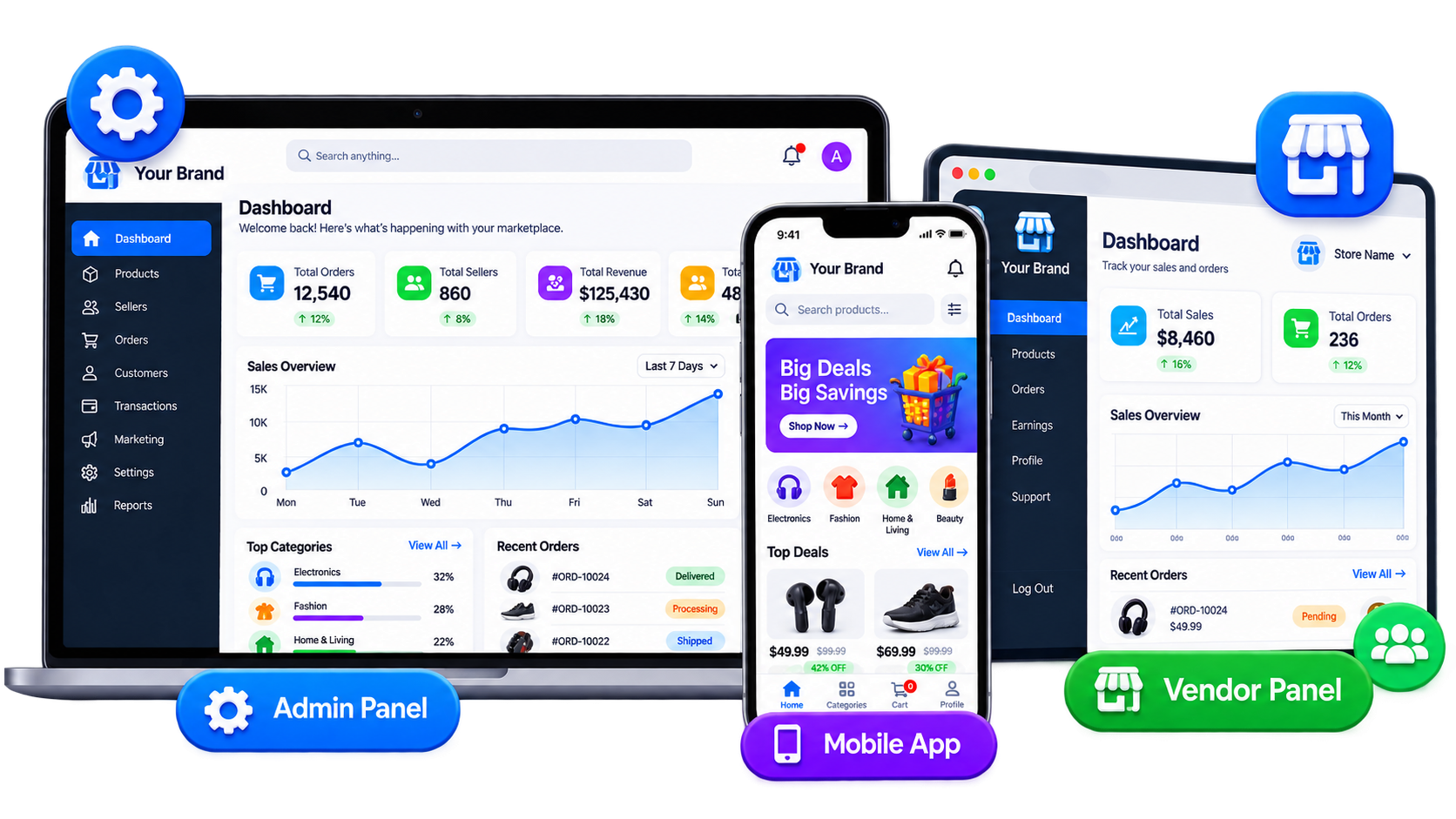
You have two main routes. Both give you a customer app, vendor panel, and admin panel, but the cost and speed are very different:
| Route | Typical cost | Time to launch | Best for |
|---|---|---|---|
| Custom build | ₹4 lakh to ₹85 lakh+ in India (CodingClave, 2026); $25,000–$45,000 for an MVP and $80,000–$200,000+ for a full platform (RaftLabs) | 8–12 weeks for an MVP, longer for a full platform | Funded teams with unusual needs |
| Ready-made source code | Much lower, since the core is already built | Days to a few weeks | Startups, first-time founders, niche marketplaces |
These are agency estimates and vary a lot by scope. The ready-made route works well when your needs are standard (vendor onboarding, catalogue, cart, payments, commissions, admin). HyperCommerce is one example: a multi-vendor marketplace with Flutter mobile apps, a Laravel admin panel, and a website, sold as source code you host and own.
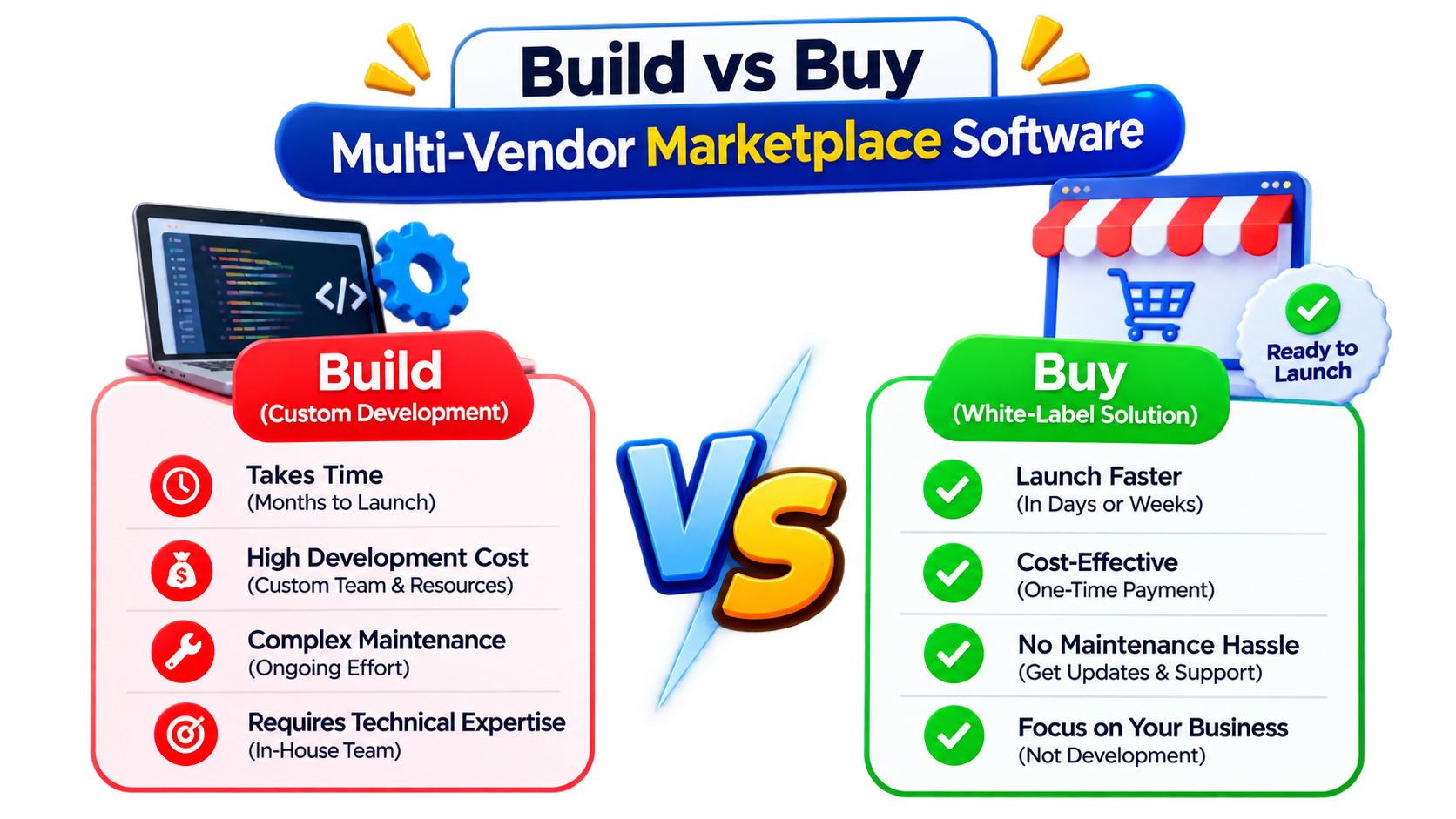
Which route fits your budget and timeline? It's a big decision, and there's no shame in asking for a second opinion.

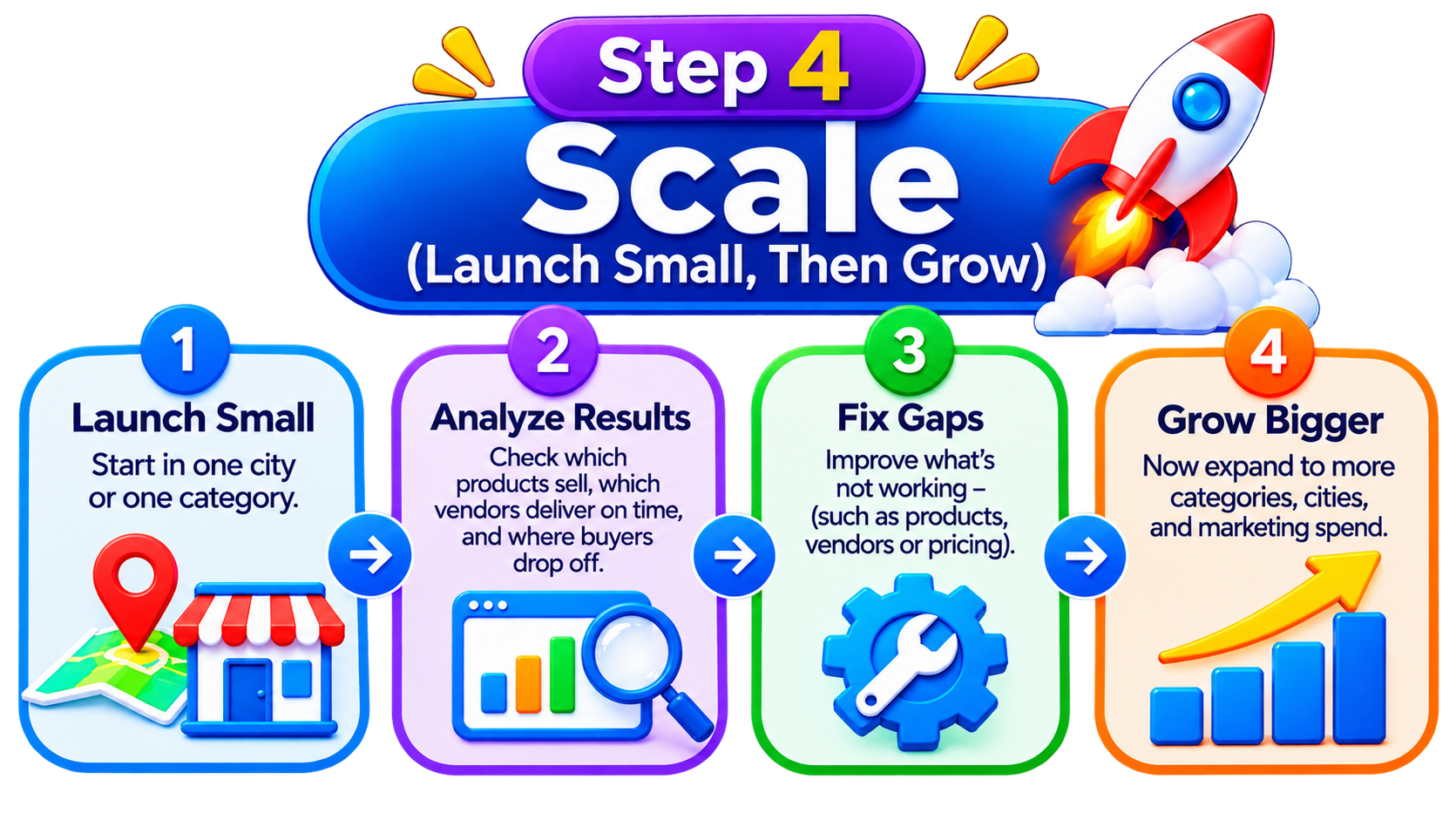
Scale: launch small, then grow
Launch in one city or one category. Watch which products sell, which vendors deliver on time, and where buyers drop off. Then fix those gaps before you add more categories, cities, or marketing spend.
What features does a multi-vendor marketplace need?
| For vendors | For buyers | For you (admin) |
|---|---|---|
| Easy sign-up and verification | Search and filters | Vendor approval and control |
| Product and stock management | Single cart for many sellers | Commission settings |
| Order tracking | Secure checkout | Payout management |
| Sales reports | Order tracking and reviews | Analytics and dispute handling |
How do multi-vendor marketplaces make money?
| Revenue model | How it works |
|---|---|
| Commission | You take a percentage of each sale. It's the most common model, and one guide puts typical rates at 15–25% (AppSierra). |
| Subscription | Vendors pay a monthly or yearly fee to sell. |
| Listing fees | Vendors pay per product they list. |
| Ads and featured spots | Vendors pay for better visibility. |
Amazon shows how big this can get: it earned $172.2 billion in 2025 from services it provides to third-party sellers (SearchLab). Your start will be far smaller, but the same ideas apply.
What mistakes should you avoid?
- Going too wide, too soon. A broad catalogue with few sellers feels empty.
- Ignoring seller quality. One late or fake seller can hurt buyer trust in the whole platform.
- Skipping legal basics. Register your business and handle GST properly. Check with a chartered accountant, since rules depend on your setup.
- Over-spending on custom features. Launch with the essentials, then add more based on real orders.
Key terms to know
- GMV (Gross Merchandise Value)
- The total value of goods sold on your platform before costs and commissions.
- Take rate
- The share of each sale that the marketplace keeps, such as a 10% commission.
- Vendor onboarding
- The process of signing up, verifying, and approving a new seller.
- Split payment
- A checkout system that divides one payment between the vendor and the marketplace.
- Dark store
- A small warehouse used only to pack and ship online orders, common in quick commerce.
Want to go deeper on related topics? Browse our blog for guides on quick commerce, delivery apps, and white-label vs custom development.
Frequently asked questions
What is a multi-vendor marketplace?
A multi-vendor marketplace is an online platform where many independent sellers list and sell products to buyers in one place. The owner runs the platform and earns a share of each sale. Amazon, Flipkart, and Meesho are examples.
How do I build a multi-vendor marketplace like Amazon or Flipkart?
Pick a focused niche, recruit sellers, set up secure payments and trust features, choose your software (custom build or ready-made source code), then launch in one area and scale. Starting small lowers cost and risk.
How much does it cost to build a multi-vendor marketplace in India?
Agency estimates range from about ₹4 lakh to ₹85 lakh or more, depending on features and scope. Ready-made source code usually costs much less than a custom build because the core platform is already built.
How do multi-vendor marketplaces make money?
Most earn through commission on each sale. Others charge vendor subscriptions, listing fees, or advertising and featured placement. Many marketplaces combine two or more of these.
What features does a multi-vendor marketplace need?
You need vendor onboarding, product and stock management, a shared cart, secure payments with split payouts, order tracking, reviews, commission settings, and an admin panel to manage sellers, orders, and disputes.
Do I need GST registration to run a marketplace in India?
Marketplace operators generally need GST registration, and sellers usually provide their GST details. Rules depend on your setup, so confirm with a chartered accountant before launching.
What is the difference between a single-vendor and a multi-vendor store?
A single-vendor store sells only one business's products. A multi-vendor marketplace lets many sellers list their own products on one platform, and the owner earns commission or fees.
Ready to build your marketplace?
If you want to launch without building from zero, take a look at HyperCommerce. Have an idea but feeling stuck? Message our team on WhatsApp and we'll help you plan the first steps.