.svg)
Hyperlocal vs HyperCommerce: Which One Fits Your Business?
 By Infinitie Technologies6 min read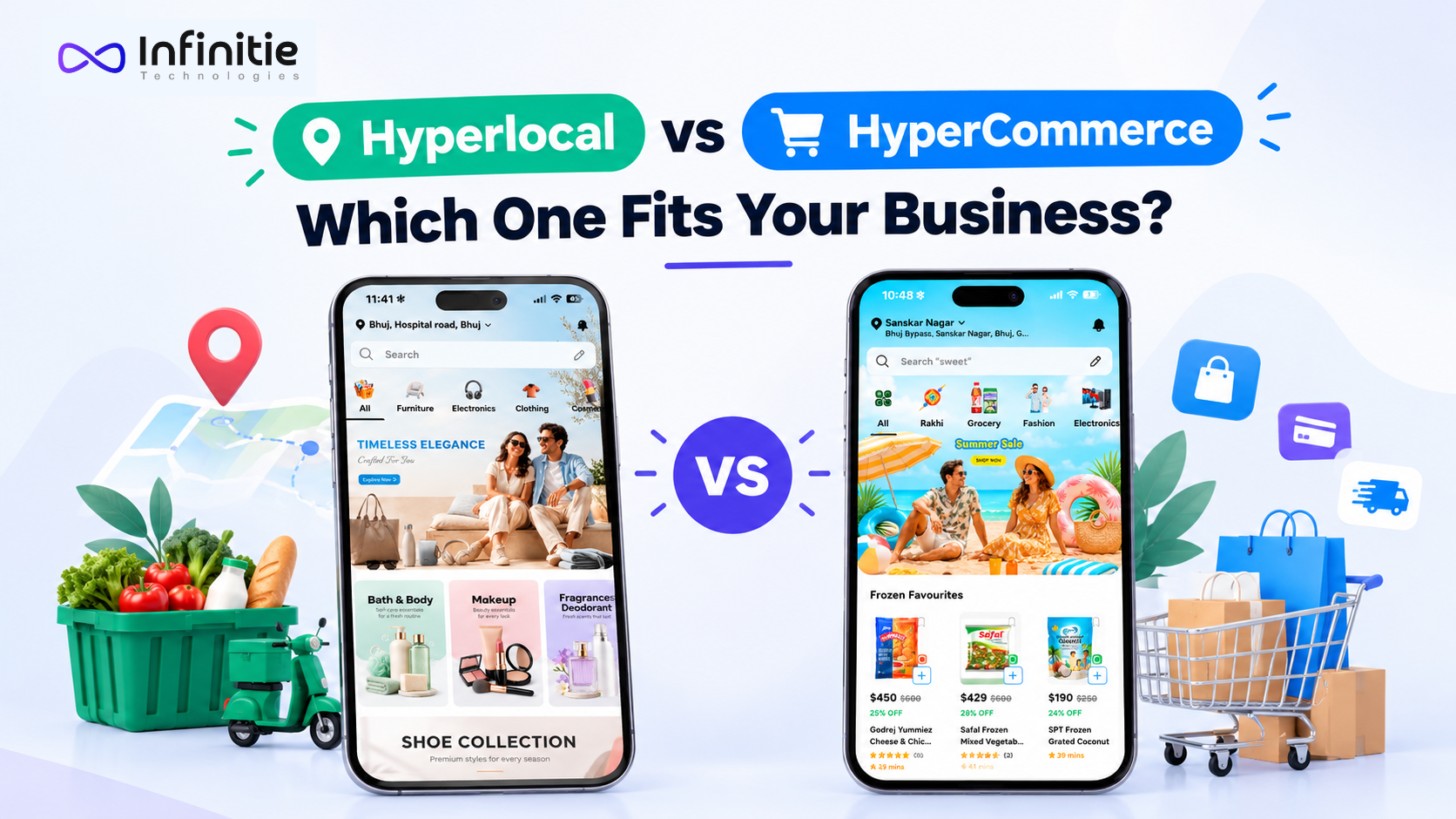
Hyperlocal is for fast local delivery of groceries, food, and medicines within one city, with riders and nearby stores. HyperCommerce is for building a multi-seller marketplace that sells a wide range of products across a city, state, or country. It backs this up with India market data from Bain and Redseer (quick commerce is growing fast, but traditional e-commerce is still over 80% of online retail).
Hyperlocal vs HyperCommerce: Which One Fits Your Business?
Quick answer: Choose Hyperlocal if you want to deliver groceries, food, or medicines from nearby stores within minutes, in one city or area. Choose HyperCommerce if you want a marketplace where many sellers list products and ship them across a city, state, or the whole country. Both are source code products: you buy once, host them on your own server, and own the code.
Why this question matters in 2026
Online shopping in India is growing on two tracks at once. According to Bain's "How India Shops Online 2026" report, India's e-retail market is expected to grow at more than 20% a year and reach $170–180 billion by 2030. Traditional e-commerce (orders delivered in days) is still over 80% of that market. At the same time, quick commerce, meaning delivery in under 30 minutes, has been doubling every year.
Redseer's research shows quick commerce was already about 17% of online retail sales and about 70% of online grocery in FY26 (Redseer). A joint Google and Redseer study expects it to grow from about $13 billion in FY26 to $90 billion by 2031.
So both models are growing. The real question is which one matches your goals, budget, and location.
What is Hyperlocal?
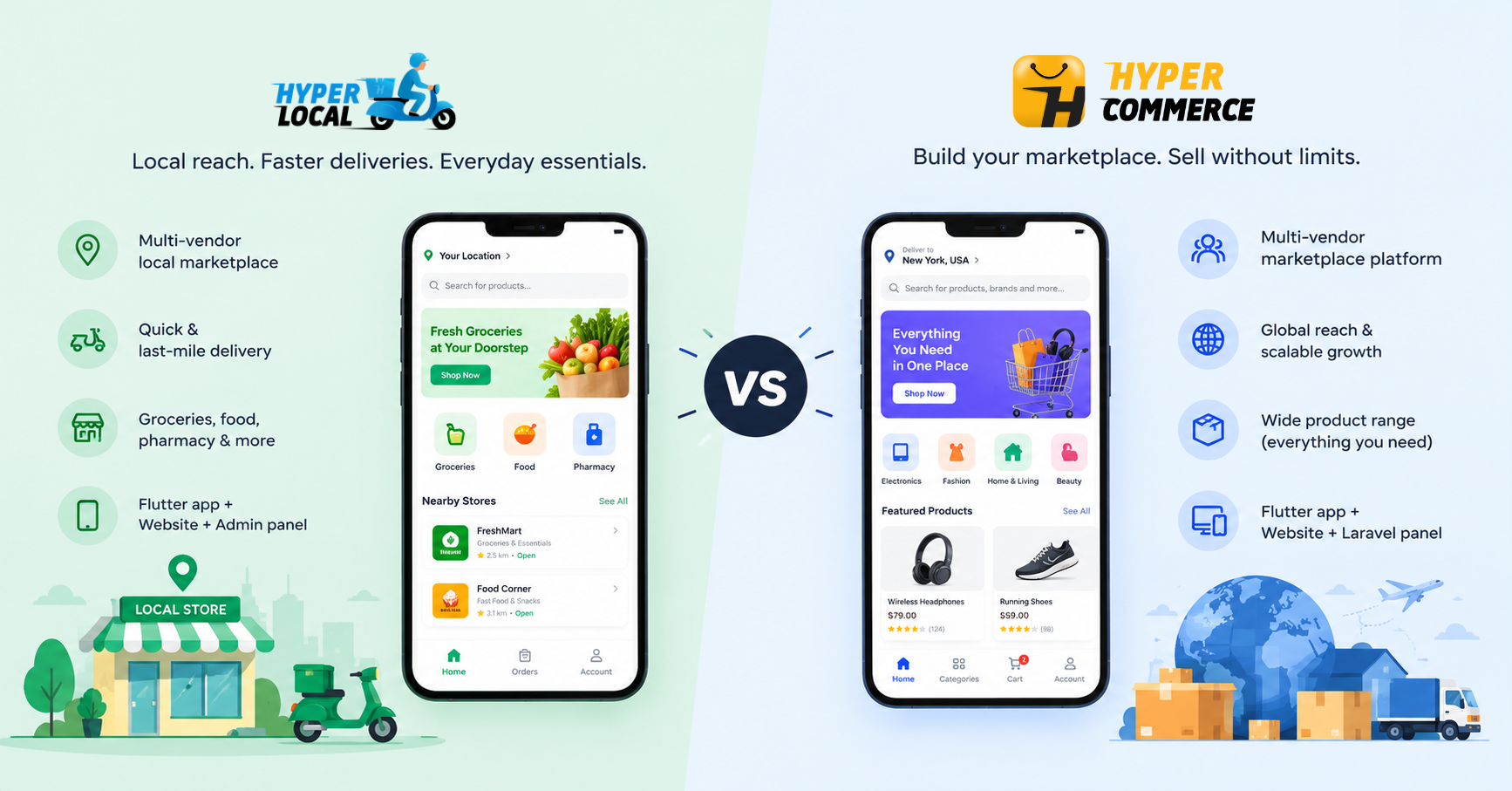
Hyperlocal is a multi-vendor delivery platform for grocery, food, and pharmacy businesses. It comes with a customer app, a rider (delivery partner) app, a seller panel, an admin panel, and a website. Orders go to nearby stores, and riders deliver them fast.
It suits people who want to build something like a local Blinkit or Zepto for their own city, town, or neighbourhood.
What is HyperCommerce?
HyperCommerce is a multi-vendor e-commerce marketplace with Flutter mobile apps, a Laravel admin panel, and a website. Sellers list their products, customers browse and buy, and you earn as the marketplace owner. Delivery is not tied to a rider reaching the customer in minutes, so you can sell to a much wider area.
It suits people who want to build something like their own Amazon or Flipkart, for a niche or a region.
Hyperlocal vs HyperCommerce: side-by-side
| Feature | Hyperlocal | HyperCommerce |
|---|---|---|
| Business model | Quick commerce (fast local delivery) | Online marketplace (e-commerce) |
| Best for | Grocery, food, pharmacy | Fashion, electronics, home, general or niche products |
| Delivery area | One city or nearby zones | City, state, or nationwide |
| Delivery speed | Minutes to a few hours | Days (standard shipping) |
| Delivery partners | Rider app built in | Courier or seller-managed shipping |
| Product type | Everyday, repeat purchases | Wide catalogue, planned purchases |
| Main challenge | Managing riders and local operations | Attracting sellers and handling shipping |
| Ownership | Buy once, host anywhere, own the code | Buy once, host anywhere, own the code |
When should you choose Hyperlocal?
- You live in or know a specific city and want to serve it well.
- You can partner with local grocery stores, restaurants, or pharmacies.
- You can manage a small team of delivery riders.
- You want customers who order again and again, because daily needs repeat.
Quick commerce is still mostly a big-city story. The Google and Redseer study says large cities will drive around 60% of the segment's growth through 2031, so starting local and focused is a sensible approach.
When should you choose HyperCommerce?
- You want to sell products beyond groceries, such as fashion, electronics, or home items.
- You want to reach customers across states without managing riders.
- You plan to earn through seller commissions, subscriptions, or listing fees.
- You want to start with a niche (for example, handmade products or local crafts) and grow from there.
This matters because quick commerce is still small in some big categories. Redseer notes that it makes up less than 5% of online fashion, mobiles, and electronics, which together are nearly 60% of India's online retail sales. Marketplace-style e-commerce remains the main route for those products.
Can you run both?
Yes, but most people do better starting with one. A local delivery business and a nationwide marketplace need different skills: one is about speed and daily operations, the other is about seller growth and logistics partners. Pick the model that matches your strengths first, then expand once you have steady orders.
Not sure which one to start with? Chat with us on WhatsApp and we'll help you figure it out.
A simple way to decide
- What are you selling? Daily essentials point to Hyperlocal. A wide range of products points to HyperCommerce.
- Where are your customers? One city points to Hyperlocal. Many cities or states point to HyperCommerce.
- How will you deliver? Your own riders point to Hyperlocal. Courier partners point to HyperCommerce.
Still confused between the two? That's completely normal. Tell us about your idea on WhatsApp and we'll point you to the right fit.
Frequently asked questions
What is the difference between quick commerce and e-commerce?
Quick commerce delivers orders in minutes, usually from nearby stores. E-commerce delivers in days, usually from warehouses or sellers across the country.
Is Hyperlocal or HyperCommerce better for a startup?
Neither is better for everyone. Hyperlocal is better if you want to serve one city with daily essentials. HyperCommerce is better if you want a wide product range and a larger delivery area.
Do I own the source code?
Yes. Both products are source code that you buy once, install on your own server, and customize as you need.
Can I customize the apps with my own brand?
Yes. Customization, reskinning, and publishing services are available for every product, so you can launch the apps under your own name and design.
Which one earns more?
It depends on your market, sellers, and operations, not on the product alone. Local delivery earns through repeat orders and delivery fees. A marketplace earns through seller commissions and a wider customer base.
Ready to pick?
If your plan is fast local delivery, take a look at Hyperlocal. If you want to build a multi-seller marketplace, explore HyperCommerce. Still have questions or feeling stuck? Message our team on WhatsApp and we'll help you choose.